
What to do after your program ends
The Post-Program Experience
This is the final part of the series on designing better program experiences. If you missed the first two, you can read about the pre-program experience here and maintaining a program once it kicks off here.
The final session of your program should not be the last time participants hear from you. There has to be a process of closing the loop, documenting lessons, and deciding what happens next for both your participants and your team.
The way you handle the post-program phase can impact how participants remember your program, if they will recommend it to others, what you learn from it, and what you have to work with the next time around.
a. The wrap-up & offboarding
The final session of your program should not be just another session that happens to be the last one. It should be something that marks the end of an experience and helps your participants recognise how far they have come and what they have accomplished. This can take many forms depending on your program’s style and scale, e.g., a closing celebration, certificates, or a final resource bundle.
This is also a good opportunity to communicate what comes next.
Depending on your program, this may involve removing access to certain resources, transitioning participants into another a community space, sharing recordings or materials, or communicating expectations around continued involvement.
Participants should know the access they will retain and the ones they will lose, where they can find resources moving forward, and how they can stay connected. An offboarding email can help to cover these details clearly and answer any other questions.
b. Feedback
While feedback should be gathered during the program, the end of the program is another opportunity to hear from your participants about their entire experience. At this stage, they have enough context to share what worked, what didn’t, and what they found most valuable.
When gathering feedback, try to understand what participants found most useful, the challenges they faced, what could be improved, and if the program met their expectations. The goal is not simply to collect positive testimonials but to gather insights that will help improve future iterations of the program.
It is also helpful to review feedback alongside your own observations throughout the program, because sometimes what participants experienced and what you observed tell different stories, but both perspectives are important.
c. Metrics
Before moving on to the next thing, there is a need to understand what your data is telling you. Not just whether the numbers looked good, but what they mean in the context of what you were trying to achieve and what you observed along the way. This helps you to move beyond assumptions and evaluate the program using actual data.
The metrics you track will depend on the type of program you run, but they may include:
Number of participants enrolled
Attendance rate
Completion rate
Engagement rate
Feedback scores
Retention metrics
Numbers will tell you what happened, and the feedback, along with your personal observations, will tell you why they happened.
d. Team debrief
The debrief conversation with your team is just as important as the metrics you measure. Get together with your team (even if it’s just you and one other person) and talk about what went well, what didn’t go as planned, and why. Evaluate your process from start to finish and the overall delivery of the program.
During the debrief, you can also begin to take note of what you would do differently for the next cohort or batch of your program.
Remember to put these observations, recommendations, and plans into a well documented format so you can always refer back to them in the future.
e. Alumni management (if applicable)
For some programs, the participant journey can transition into an alumni community. This can extend the value of your program by helping participants to continue learning, build relationships, share opportunities, and stay connected to your brand or organisation.
It does not have to be elaborate. It can be a channel within your community space, an email list, or even a simple group that keeps people connected.
On your end, you need to keep showing up with value; share relevant resources, invite them to future programs, celebrate their wins, and check in at meaningful moments. These are the things that will keep the community alive.
f. Sunsetting (if applicable)
Most programs are one-off and do not need a next cohort or batch, and that is perfectly fine. Some may need to be paused and redesigned before they run again. Whatever the case, the absence of a “next time” does not change how you close the current one.
For one-off programs, the post-program focus shifts entirely toward what participants take away and how they are transitioned out. What do they leave with? Where do they go from here? What resources, connections, or next steps can you point them toward, even if those things exist outside of your program?
Your job at this stage is not just to end the program but to help your participants feel equipped for whatever comes after it.
If your program is being paused or redesigned, communicate that clearly. If there is a possibility of a future cohort, let them know. If you are not sure yet, communicate that too.

The end of a program does not always mean the same thing. For some, it is a transition into an alumni experience. For some, it is the beginning of planning the next cohort. And for others, it may be the moment to pause, redesign, or retire the program altogether.
Whatever comes next, the post-program phase is where the full value of everything you built gets consolidated, reflected on, and carried forward.
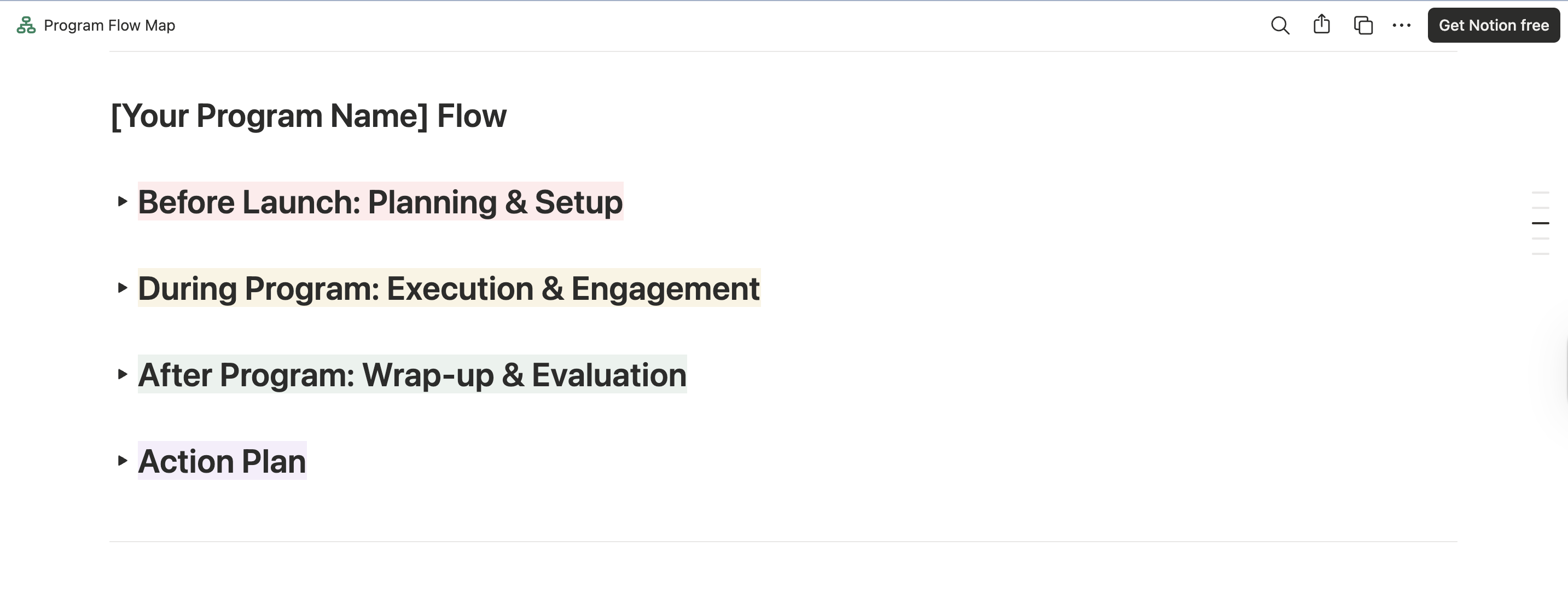
If you found this helpful and want a practical tool to help you think through the full program journey (from planning, delivery, and wrap-up), I created a FREE Program Flow Map that covers every stage we have discussed across this series and gives you a structure to work from for any program you run.
Thank you for reading!
Feel free to drop a comment and pass this on to a friend.